
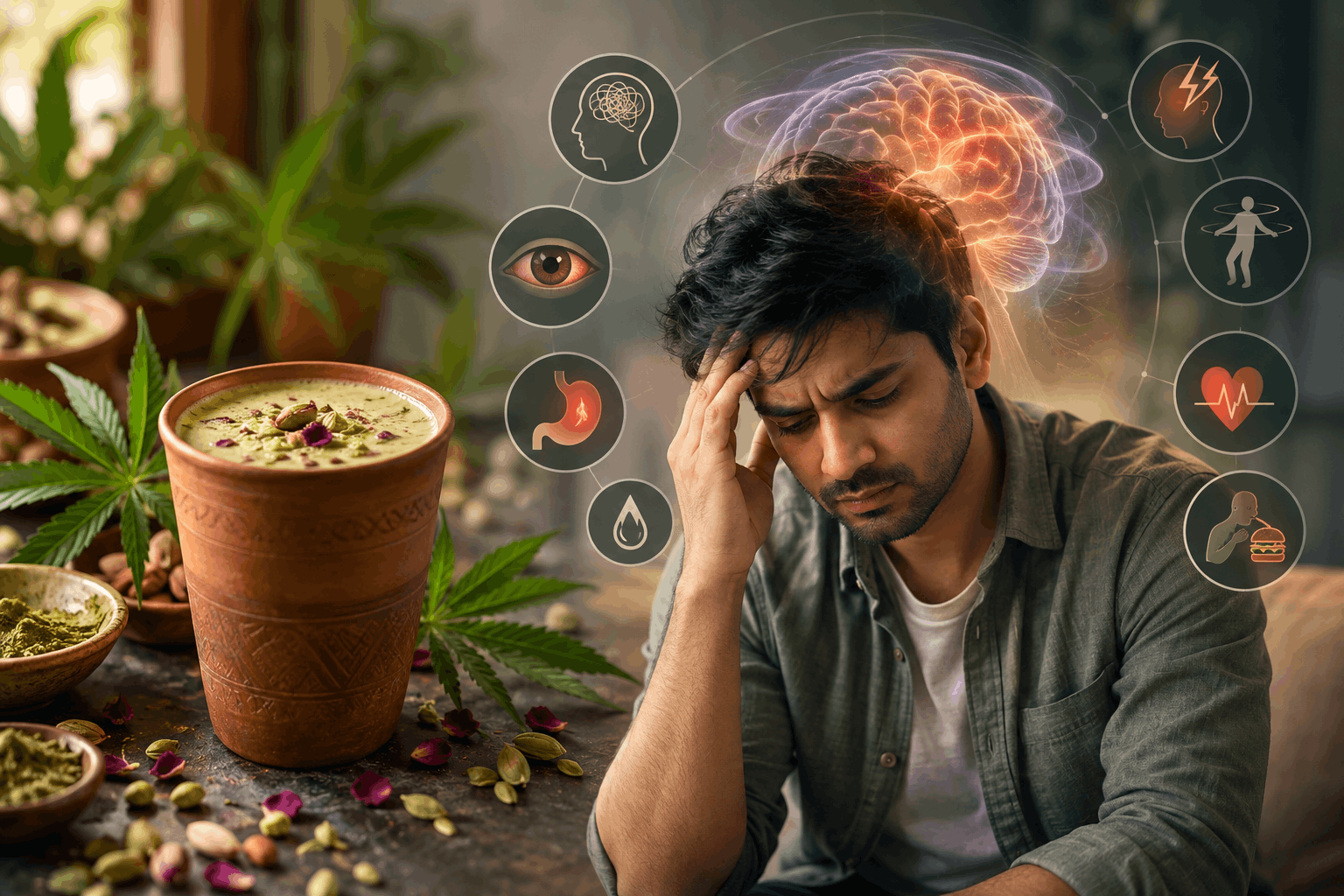
Most people meet bhang at Holi or Shivratri, in a glass of thandai that tastes like a festival treat. That is exactly why it catches people off guard. Bhang effects are slow to arrive and slow to leave, so the side effects of bhang can feel mild for the first hour and then land hard, long after a second glass has gone down. This blog explains what bhang does to the brain and the body, how the risks change with the form you take, how long the effects last, what actually helps when someone has taken too much, and the point at which festival use turns into something that needs treatment.
How Bhang Works, and Why the Timing Trips People Up
Bhang is made from the leaves of the cannabis plant, ground into a paste and stirred into drinks, sweets, or small balls. The active ingredient is THC, the same compound found in ganja and charas. What changes everything is the route. Bhang is swallowed rather than smoked, so THC travels through the stomach and liver before it reaches the brain. Health Canada notes that the liver converts it into a stronger form called 11-hydroxy-THC, which is one reason a swallowed dose can feel more intense than an inhaled one.
That single fact explains most bhang mishaps. So how long does bhang last, and when does it begin? For cannabis that is eaten or drunk, Health Canada gives clear ranges.
- Effects usually begin 30 minutes to 2 hours after you take it.
- Full effects can take up to 4 hours to arrive.
- Effects can last up to 12 hours, with residual effects for up to 24 hours.
A first-timer who feels nothing after half an hour often decides the batch is weak and takes more. By the time the first dose lands, the second is already on its way, and both arrive together. This is why Health Canada advises waiting up to 4 hours after eating or drinking cannabis before taking any more. Smoked cannabis behaves in the opposite way, starting within seconds to minutes and reaching full strength in 10 to 30 minutes, which makes it far easier to judge. Bhang effects give no such warning.
Is bhang and ganja the same?
They come from the same plant, which is why the question comes up so often, but they are not the same preparation, and Indian law does not treat them alike. Bhang is made from the leaves. Ganja is the flowering and fruiting tops. Charas is the separated resin. The part of the plant matters, because THC is not spread evenly through it. UNODC figures put cannabis leaves at roughly 1 to 2 percent THC and flowers at 10 to 12 percent, with resin higher again.
That gap is real, and it is also the source of a dangerous misreading. Low THC per gram does not mean a low dose. A bhang drink is made by grinding a quantity of leaf into milk, and nobody weighs it. How much THC ends up in the glass depends on how much leaf went in, which is why two glasses poured at the same gathering can affect two people very differently.
Difference Between Ganja and Bhang
The practical differences sit in four places: the part of the plant, the strength, how the body takes it in, and the legal position.
| Bhang and ganja compared | Bhang | Ganja |
|---|---|---|
| Part of the plant used | Leaves and seeds | Flowering and fruiting tops |
| THC per gram | Lower. Leaves run about 1 to 2 percent | Higher. Flowers run about 10 to 12 percent |
| Usual route | Swallowed in drinks, golis, and sweets | Usually smoked |
| When it starts | 30 minutes to 2 hours | Seconds to minutes |
| How long it lasts | Up to 12 hours | Up to 6 hours |
| Judging the dose | Poor. The amount is never measured | Easier to feel and stop |
| Under the NDPS Act, 1985 | Leaves and seeds not accompanied by the tops fall outside the definition of cannabis | Covered as cannabis |
The legal difference is the one most often stated wrongly. The Narcotic Drugs and Psychotropic Substances Act, 1985 defines cannabis as charas, ganja, and any mixture or drink prepared from them. Ganja is defined as the flowering or fruiting tops, excluding the seeds and leaves when not accompanied by the tops. Leaf bhang therefore sits outside that definition, and several High Courts have read it the same way, though the Supreme Court has not settled the question.
None of that makes bhang legal across India. Bhang is controlled by state excise law, so the rules differ from one state to the next, and some states license retail bhang shops while others do not. A preparation made with flowering tops or resin is covered by the NDPS Act, whatever the seller calls it.
Bhang Side Effects on Brain
THC acts on the parts of the brain that handle memory, emotion, judgment, and coordination, so that is where the first bhang side effects on brain function show up. Health Canada lists impaired ability to remember, to concentrate, to pay attention, and to react quickly among the short-term effects of cannabis. Most people also notice a stretched sense of time and clumsy movement. Reaction time drops, which is why driving or riding after bhang is genuinely unsafe. Mood can swing from giggly to anxious inside the same hour.
After a large dose, these effects sharpen into intense anxiety, paranoia and confusion, and in some people a frightening break from reality with hallucinations. The World Health Organization notes that a minority of first-time users become very anxious, have panic attacks, experience hallucinations and vomit.
The link with psychosis deserves care, because it is often overstated in both directions. Health Canada describes strong evidence that cannabis use may increase the risk of developing psychosis and schizophrenia, with roughly a 40 percent increase in risk associated with any use, rising to two or three times for daily users, and 2.5 to 10 times for people with a family history of psychosis. There is a clear dose-response pattern. It is equally honest to say that the rate of schizophrenia in the population has not climbed alongside cannabis use, and the mechanism is still largely unknown. The accurate reading is that cannabis is one contributing cause among several, not a single switch that turns the condition on.
Age matters more than most people expect. Health Canada reports that the effects appear worse when use starts early in adolescence and continues often, and that they can last from days to months after stopping and may not be fully reversible. Where low mood, anxiety, or a psychotic illness is already part of the picture, addiction care and mental health care have to run together, which is how the conditions we support at Vaishalya Wellness are handled.
Bhang Effect on Body
The bhang effect on body systems is easy to dismiss until a dose is too big. The familiar ones are a racing or pounding heartbeat, a drop in blood pressure that brings dizziness on standing, dry mouth, red eyes, and a sharp rise in appetite. Nausea is common, and a heavy dose can bring repeated vomiting, cold sweats, and the pale, faint state people call greening out.
For a healthy adult, most of this is unpleasant rather than dangerous, and it passes. The heart is where the real caution lies. Health Canada notes that the rise in heart rate is risky for people with heart conditions and can raise the risk of a heart attack, while the fall in blood pressure can make people faint. One well-known case-crossover study found the risk of a heart attack was several times higher in the first hour after smoking cannabis, falling away after that. Evidence for swallowed forms is thinner, so this is a reason for caution rather than a settled finding about bhang.
The bhang side effects on body movement cause their own trouble. Falls and accidents during the dizzy, uncoordinated phase are common and hit older people hardest. None of it is helped by the setting, since bhang is usually taken in a crowd, often on an empty stomach or alongside alcohol.
How the Side Effects Change With the Form You Take
Bhang reaches people in several forms, and each one changes how fast the dose arrives and how easy it is to take too much.
Bhang Drink Side Effects: Thandai and Lassi
This is the classic festival form. Bhang paste is whipped into milk, nuts, and spices, so the bitterness disappears and the glass goes down like dessert. The familiar flavor is the trap. Bhang drink side effects follow the slow-onset pattern at its most extreme, because a large glass is easy to finish and a second is easy to pour long before the first has done anything.
Bhang Goli Side Effects
Goli are small balls of ground bhang, and bhang ka gola is the same idea in a larger lump. Both are swallowed in seconds and look harmless. Strength is the problem. A goli carries no label, so two people taking the same number can end up in very different states. Bhang goli side effects are therefore harder to predict than the drink, and people often swallow several before anything registers, then meet all of them at once. You may also hear bhola used as a street name in some regions. It refers to the same leaf preparation, not to a milder product.
Bhang Chocolate Side Effects and Other Edibles
Bhang now turns up baked into chocolates, cookies, and gummies, and these are the riskiest forms for two reasons. A tasty edible is easy to overeat without thinking, and the THC packed into one piece can be high. Bhang chocolate side effects also arrive late, often two hours after the last bite, which is long enough to eat three more. Edibles that look like ordinary sweets are a serious hazard to children at home, and poisoning cases in young children have needed intensive care.
Bhang Seeds Side Effects
This one needs a plain answer. Cannabis seeds carry almost no THC, so bhang seeds side effects are usually limited to mild stomach upset if a lot are eaten, and plain seeds do not produce a high. The catch is what gets sold as seeds. If the product is mixed with leaf or resin, or confused with ground bhang, the usual THC effects follow. Treat any seed product you cannot verify as though it could be active, and keep it away from children.
Side Effects of Eating Bhang Versus Smoking Bhang
Some people smoke the plant instead of swallowing the paste, and the two routes behave very differently. The side effects of eating bhang come on slowly and last far longer, which is what makes an accidental overdose so easy. The side effects of smoking bhang begin within minutes and fade sooner, so the dose is easier to control, but smoking brings its own damage, since hot smoke irritates the throat and lungs and causes coughing and breathing trouble over time.
| How it compares | Eating or drinking bhang | Smoking cannabis |
|---|---|---|
| When it starts | 30 minutes to 2 hours | Seconds to minutes |
| Full effect | Up to 4 hours | 10 to 30 minutes |
| How long it lasts | Up to 12 hours | Up to 6 hours |
| Judging the dose | Hard and easy to overshoot | Easier to feel and stop |
| Main added risk | Delayed overdose from taking a second dose too soon | Throat and lung irritation |
How to Reduce Bhang Effects
Start with the honest part, because it is the part most articles skip. There is no antidote for a bhang high and nothing that clears THC from the body on demand. Time is the only thing that brings it down. What you can do is make the wait safer and less frightening, which matters, because most of the harm from too much bhang comes from panic, falls, and bad decisions rather than from the THC itself.
How to Reduce Bhang Effect Immediately
In the first hour, the aim is to stop the dose from climbing and keep the person safe.
- Take no more. This is the single most useful step. Health Canada advises waiting up to 4 hours after a swallowed dose before considering anything further, and during a bad reaction the answer is simply none.
- Sit or lie down. Blood pressure can drop on standing, so staying low reduces the risk of fainting and falling.
- Move somewhere quiet. Crowds, loud music, and bright light make anxiety worse. A calm room with someone familiar nearby helps more than anything in a kitchen cupboard.
- Sip water slowly. It will not clear the THC, but it helps with dry mouth and with the dehydration that comes from vomiting.
- Do not drive or ride. Coordination, reaction time, attention, and judgment of distance are all impaired, and the impairment outlasts the feeling of being high.
- Do not add anything. No alcohol, no more bhang, no unprescribed sedatives, and no strong coffee.
How to Reduce Bhang Effect Immediately at Home
At home, the job is supportive care and watching. Keep the person company rather than leaving them to sleep it off alone, especially if they have vomited. Remind them in plain words that this is the bhang, that nothing is permanently wrong, and that it will fade. Reassurance works well for bhang panic. Offer a little plain food if they can manage it, let them rest on their side if they feel sick, and keep the room cool and dim. Someone should stay awake with them until the worst has passed.
It is worth being direct about the home remedies that circulate every Holi. Lemon water, black pepper, ghee, curd, and tamarind are all recommended online as ways to bring a bhang high down. No health authority supports any of them, and there is no clinical evidence that any of them reduce THC effects. They are unlikely to cause harm, but relying on them wastes time and can delay a call for help that someone actually needs. If home steps are not settling things, or you are unsure how much was taken, speak to a doctor rather than waiting it out, and our counselors and doctors can talk through what to watch for.
When Too Much Bhang Becomes an Emergency
Picture a first-timer at a Holi gathering. At noon she drinks one glass of thandai, feels nothing by half past twelve, and takes a second because everyone swears it is harmless. Around half past two, both doses arrive together. Her heart is pounding, the room tilts, and she is certain she needs a hospital. Nothing is permanently wrong, and the bhang will fade by night, but the hours in between are frightening and were avoidable.
Searches for bhang overdose death are common, and the honest answer is reassuring without being casual. The World Health Organization reports no fatal cannabis overdoses in the epidemiological literature and describes the risk as extremely small, because THC does not suppress breathing the way opioids do. What is documented is indirect harm: road crashes and falls while coordination is impaired, cardiac events in vulnerable people, and severe poisoning in children who swallow edibles. Mixing bhang with alcohol makes all of it worse, and anyone who needs both to get through a social occasion should look at alcohol dependence care as well.
Call 112, or 108 for an ambulance, if the person cannot be woken or is severely drowsy, has chest pain or difficulty breathing, vomits repeatedly and cannot keep fluids down, has a seizure, becomes aggressive or deeply paranoid, sees or hears things that are not there, or talks about harming themselves. Do not wait it out if the person is a child, is pregnant, is elderly, or has a heart or mental health condition. A child who has swallowed any cannabis edible should be seen the same day, whatever the amount.
Long-Term Side Effects of Bhang
Occasional festival use is one thing. Regular use is where the long-term side effects of bhang accumulate. The body adapts, the same amount does less, and people take more to reach the old effect. That tolerance is the first step toward dependence, and dependence is far more common than the festive image suggests.
The National Institute on Drug Abuse estimates that 22 to 30 percent of people who use cannabis have cannabis use disorder, and that starting young raises the risk. Over months and years, heavy users often report ongoing memory and attention problems, low motivation that families read as laziness, broken sleep, and higher rates of anxiety and low mood. People who smoke their bhang add airway damage on top.
Withdrawal is real and is recognized in both DSM-5 and ICD-11. A 2022 clinical review puts the pattern at onset within 24 to 48 hours of stopping, a peak between days two and six, and most symptoms settling over two to three weeks, with sleep taking longer. Expect irritability, anxiety, anger, disturbed sleep and vivid dreams, low mood, reduced appetite, sweating and strong cravings. Knowing the shape of that first fortnight matters, because many people relapse simply because nobody warned them how rough it would feel.
A smaller group develops cannabinoid hyperemesis syndrome, a cycle of severe nausea, vomiting and abdominal pain in long-term users, often with a compulsive urge to take hot showers for relief. Hot water eases it briefly but does not fix it, and stopping cannabis is the only known permanent remedy. If vomiting keeps returning in someone who uses regularly, that is a reason to get assessed rather than to keep treating the stomach. Families who are unsure where the line sits can start by working out whether rehab is needed.
Is bhang good for health?
This question deserves a straight answer, because the belief that bhang is natural and therefore harmless is doing real damage. Bhang has a long and genuine place in religious and cultural practice in India, and that meaning is not in dispute. Cultural importance is not the same as medical benefit.
There is no credible clinical evidence that bhang, as it is actually consumed in India, treats any condition. The confusion comes from a real but separate body of research on cannabinoid medicines. The United States Food and Drug Administration has approved a purified cannabidiol solution for two rare seizure disorders, and synthetic THC products for chemotherapy-induced nausea and for appetite loss in AIDS patients. Those are purified single molecules, at measured doses, for named diagnoses, on prescription. The same agency states that it has not approved cannabis itself for the treatment of any disease or condition.
A glass of festival thandai is the opposite of that. The dose is unmeasured, the THC content is unknown, nothing is standardized, and there is no diagnosis involved. Claims that bhang aids digestion, relieves pain, lifts mood or improves sleep are not supported by clinical evidence. The low THC figure sometimes quoted for leaves also gets misused: a lower concentration per gram says nothing about how much leaf went into a particular drink.
Bhang Side Effects Treatment and Support
Managing one bad reaction after a festival is first aid. Needing to do it repeatedly, or using bhang to get through work or to fall asleep, is a different matter. The national household survey on substance use in India found that about 2.8 percent of Indians, roughly 3.1 crore people, had used a cannabis product in the previous year, with bhang accounting for about 2 percent, and that around 72 lakh people need help for cannabis-related problems. That last number is the one worth sitting with, because very few of those people are in treatment.
Use has crossed into dependence when several of these appear together over months: using far more than planned, repeatedly failing to cut down, needing more for the same effect, giving up other activities, and continuing despite memory problems, money trouble, low mood or conflict at home.
Bhang side effects treatment follows the same path as other cannabis dependence care, and it works. It starts with an honest assessment of how heavy the use is and whether anxiety, depression or psychosis is also present. Where withdrawal is likely to be difficult, a short period of medically supervised care steadies the first days. The core of recovery is talking therapy. Cognitive behavioral therapy, motivational enhancement therapy and contingency management have the strongest evidence behind them, and combining them works better than any one alone. No medication is approved anywhere for cannabis dependence, so any center promising a pill that ends it is overselling. Our treatment approach pairs that therapy with family sessions and a written relapse-prevention plan.
Vaishalya Wellness is a residential rehabilitation center in the hills above Palampur, in the Kangra valley, and runs as a nasha mukti kendra for families across Himachal Pradesh and beyond. If you would rather start with a government service, the de-addiction helpline on 14446 offers counseling and referral, and Tele-MANAS provides free mental health support around the clock on 14416.
This blog is general information and not a diagnosis, so a proper assessment with a qualified professional is the right next step for any real concern. Bhang wears a festive, harmless image, but the side effects of bhang are real, and asking for help early is far easier than waiting for a crisis.
Frequently Asked Questions
How long does bhang last?
Effects from bhang that is eaten or drunk usually begin 30 minutes to 2 hours after you take it, build to full strength over about 4 hours, and can last up to 12 hours, with residual effects for up to 24 hours. Tiredness and a foggy head often carry into the next day. Smoked cannabis starts within minutes and fades sooner.
Does bhang have side effects?
Yes. Bhang carries the same THC as other cannabis preparations, so it affects both the brain and the body. Common effects include slowed thinking, patchy short-term memory, poor coordination, a faster heartbeat, a drop in blood pressure, red eyes, and dry mouth. Larger doses can bring intense anxiety, paranoia, and vomiting.
Can you die from too much bhang?
A fatal overdose from cannabis alone has not been reported in the research literature, and the World Health Organization describes that risk as extremely small. The real dangers are indirect: road accidents and falls while coordination is impaired, heart strain in people with a heart condition, and severe poisoning in a child who swallows an edible. Any of those needs emergency care.
Are bhang seeds safe to eat?
Cannabis seeds carry almost no THC, so plain seeds do not cause a high and are unlikely to do more than upset the stomach if eaten in quantity. The risk is what gets sold as seeds. If the product is mixed with leaf or resin, or confused with ground bhang, the usual THC effects follow. Keep any seed product you cannot verify away from children.
What is the difference between eating and smoking bhang?
Eaten bhang starts slowly, takes up to 4 hours to reach full effect, and can last up to 12 hours, which makes it easy to take too much before the first dose lands. Smoked cannabis starts within seconds to minutes and fades within about 6 hours, so the dose is easier to judge, but smoking irritates the airways and causes damage over time.
Is bhang addictive?
Yes. Bhang delivers the same THC as ganja, and regular use can lead to tolerance, cravings, and a recognized withdrawal syndrome. The National Institute on Drug Abuse estimates that 22 to 30 percent of people who use cannabis have cannabis use disorder, and the risk is higher for those who start young. A festive image makes dependence easy to miss.
What should you do if someone takes too much bhang?
Keep them in a quiet place where someone can stay with them, offer small sips of water, and remind them that the feeling will pass. Do not give alcohol, more bhang, or unprescribed sedatives, and do not let them drive. Call 112 or 108 in India if they cannot be woken, have chest pain or trouble breathing, vomit repeatedly, or become severely agitated or paranoid.
Is bhang and ganja the same thing?
They come from the same plant but are different preparations. Bhang is made from the leaves, ganja from the flowering tops, which carry far more THC per gram. Bhang is usually swallowed, and ganja is usually smoked, so they differ in how fast they act and how long they last. Indian law also treats them differently under the NDPS Act.
Talk to Vaishalya Wellness
A confidential conversation is the simplest place to start. Our helpline is open 24 hours, and you can message us on WhatsApp whenever it suits you.
Prefer to write? You can send us a message, and the admissions team will call you back.
