



- Resources
- Volunteer
- Internship
- Our approach
- FAQ
Individual Therapy for Women in Recovery
Private, one-to-one sessions with your counsellor, with a consultant psychiatrist overseeing the clinical plan. Held in a women-only residential setting in the Kangra valley, structured, unhurried, and built around what you are actually carrying.

- Session length
- 50 to 60 minutes
- Typical frequency
- Weekly to begin
- Oversight
- Consultant psychiatrist
Why one-to-one work sits at the centre
Addiction is rarely the whole story. Underneath it there is usually something older: a marriage that stopped feeling safe, grief no one made room for, years of being the person who holds everyone else together. Group work and daily structure help enormously, but there are things a woman will only say once, quietly, to one person she has come to trust.
That is what individual therapy is for. It is the one hour in the week where nothing has to be managed for anybody else. Your counsellor is not there to assess whether you are trying hard enough. She is there to help you understand why the substance made sense to you, and what has to change so that it stops making sense.
At Vaishalya, individual sessions run alongside everything else in the programme. What surfaces in a group is picked up here in private. What you work out here shapes how you use the rest of the week.
What a session actually looks like
The first session is mostly listening. Your counsellor will ask about the substance and the pattern of use, but she will spend at least as long on the rest of your life: sleep, family, work, health, what a normal day looks like, who knows and who does not. Nothing is written down that you have not agreed to.
From the second session onward there is usually a shape to the work:
- Where things stand. A short check on the week: cravings, sleep, mood, anything that went badly or unexpectedly well.
- The main piece. One thing worked through properly rather than five things touched lightly. Often a relationship, a memory, or a recurring trigger.
- Something to carry out. A small, specific practice for the week. Not homework in the school sense, and not something you are graded on.
Sessions are not recorded. What you say stays between you and your counsellor, with the single exception of a genuine risk to your life or someone else's, which will be explained to you plainly in the first session.
You do not have to arrive with the right words. Most women start with “I don't know where to begin,” and that is a perfectly good beginning.
The approaches we draw on
We do not run one method over every person. Your care is planned by a consultant psychiatrist and delivered by trained counsellors, who choose the approach that fits you and change it when it stops fitting. Medication, where it is needed, is prescribed and reviewed by the psychiatrist rather than left to run on unchecked.
Cognitive Behavioural Therapy (CBT)
Practical work on the loop between a thought, a feeling, and a drink or a dose. Useful early, when the immediate need is to interrupt the pattern rather than explain it.
Dialectical Behaviour Therapy (DBT)
Where CBT works on the thought, DBT works on the feeling that arrives before the thought has a chance. It teaches four things directly: distress tolerance, emotion regulation, mindfulness, and interpersonal effectiveness. We reach for it most often with women whose use follows emotional swings they experience as unbearable, and with women who have a history of self-harm alongside the substance.
Motivational Interviewing
For the very common position of wanting to stop and not wanting to stop at the same time. Rather than arguing you out of the second half, we work with the ambivalence directly.
Mindfulness-Based Relapse Prevention (MBRP)
A craving is a wave. It rises, peaks, and falls whether or not you act on it, usually inside twenty minutes. MBRP trains you to notice the wave and stay still through it rather than being carried. It runs alongside the morning yoga and breathwork already built into the daily programme, so the practice is not something extra to remember.
Trauma-informed practice
A large share of women in de-addiction treatment have a history of abuse, violence, or long-term neglect. We do not push you into that material before you are steady enough to hold it, and we never treat it as an excuse being made.
Relapse prevention planning
Concrete, written, and specific to your life: the festivals, the relatives, the hours of the day, the people who will offer. Built with you before you need it, not after.
Who this is right for
- Women using alcohol, prescription medication, chitta or other opioids, cannabis, or a combination
- Women who have completed a detox elsewhere and need the psychological work that follows
- Women whose drinking or use is tied closely to anxiety, depression, or an abusive relationship
- Women who relapsed after an earlier attempt and are convinced it means they cannot do it
- Families wanting guidance on how to support someone without either enabling or abandoning her
If what you are describing needs medical supervision, such as heavy daily alcohol use, opioid withdrawal or seizures, we will tell you that directly and help arrange supervised detox first. Therapy works far better on the other side of it.
- Group size
- 6 to 10 women
- Session length
- 75 to 90 minutes
- Facilitation
- Always counsellor-led
Why recovery is harder alone
Shame is the strongest force working against a woman in recovery, and it does its worst work in isolation. A woman who drinks in Himachal is not judged the way a man who drinks is judged. She is judged as a mother, a wife, a daughter-in-law. She hides it longer, asks for help later, and arrives convinced she is the only one.
Twenty minutes into her first group, she finds out she is not. That single realisation does more than a month of persuasion. Someone across the circle describes hiding a bottle in exactly the place she hid hers, and the story she has told herself about being uniquely broken starts to come apart.
Almost every woman who comes to us resists the group. Almost every one of them, on the day she leaves, names it as the part that changed things.
How our groups are run
Group therapy is not a room of people taking turns to talk. It is a clinical intervention, and it is run like one.
- Women only. Every group, every time. This is not a preference, it is the condition that makes the honesty possible.
- Small and closed. Six to ten women, and the membership does not change mid-cycle. Trust cannot build in a room where the faces keep changing.
- Counsellor-led. A trained counsellor facilitates every session. She is there to keep the room safe, to stop advice-giving from taking over, and to make sure quieter women are not talked past.
- Regular, not occasional. Groups run to a fixed weekly rhythm. The predictability is part of the treatment.
- Language. Sessions run in Hindi, Pahari, and English as the room requires. No one has to translate her own life.
The four kinds of group
Process group
The core session. Open material — whatever is live in the room that week. Relationships, guilt, anger at family, fear of going home. The facilitator holds the frame; the women do the work.
Relapse prevention group
Structured and practical. Mapping high-risk situations, rehearsing refusals out loud, dismantling the specific thought that precedes a lapse. Members hold each other to plans in a way a counsellor alone cannot.
Skills group
Teachable material with immediate use: distress tolerance, sleep repair, managing anger without turning it inward, saying no to a relative without a scene. Taught, practised, then taken home.
Family therapy and reintegration
Structured family therapy, held on scheduled days with family members present. Addiction is not a private illness. It reorganises a whole household around itself, and by the time a woman reaches treatment the people at home have usually built their own habits around her use: covering for her, policing her, or withdrawing from her entirely. Those patterns do not dissolve because she got sober.
The work is to name them without allocating blame, and to agree what changes on both sides before she returns. Husbands, mothers, mothers-in-law and adult children are all worked with, and where a home is unsafe we say so plainly rather than sending a woman back into it. This group is often the hardest and the most necessary.
Ground rules and confidentiality
Every group opens with the same agreement, and every member commits to it in her first session:
- What is said in the room does not leave the room. Not to family, not to other residents, not afterwards.
- You may pass. Nobody is made to speak, and silence is not treated as resistance.
- No advice unless it is asked for. Shared experience, not instruction.
- No comment on anyone's caste, religion, income, or family situation.
- Nothing is photographed or recorded, by anyone, at any time.
A woman who breaks confidentiality leaves the group. It has almost never had to happen, and the reason is that everyone in the room understands exactly what it would cost her if it were her story being repeated outside.
- Platform
- Secure video call
- Between sessions
- WhatsApp text support
- Hours
- Mon to Sat, 10am to 5pm
Who online counselling suits
In the hills, distance is a real clinical problem. A woman in an interior village may be four hours from the nearest qualified counsellor, and the journey itself requires an explanation she does not want to give. Online counselling removes both obstacles.
- Women who cannot travel: distance, no vehicle, small children, no one to cover the household
- Women who cannot be seen walking into a de-addiction centre in their own town
- Women continuing care after a residential stay, so that support does not stop the day they go home
- Working women who can protect an hour but not a day
- Families outside Himachal seeking guidance for a woman who is not yet willing to come in herself
- Anyone who wants one conversation before deciding whether to commit to anything at all
What it can and cannot do
We would rather be honest than convenient about this.
Online works well for
Motivational work, CBT, relapse prevention planning, anxiety and depression running alongside the addiction, family guidance, and aftercare following a residential stay. On this material the research is clear that video sessions hold up against in-person work, and our own clients bear that out.
Online is not enough for
Physical withdrawal from alcohol or opioids. Detox needs medical supervision. Withdrawal from heavy alcohol use in particular can cause seizures and can kill. It cannot be managed over a call, and we will not pretend otherwise.
It is also not the right container when someone is in acute crisis, is at risk of harming herself, or is living in a house where she is being actively harmed. In those situations we will say so in the first conversation and help you find the level of care that is actually needed, including a residential stay with us, or a hospital if that is the honest answer.
A counsellor who tells you everything can be handled online is selling you a session. We would rather you got the right treatment.
How a session runs
- Booking. Call or send the form on this page. Someone speaks to you first, briefly, to work out whether online is the right starting point.
- The link. A private video link arrives on WhatsApp shortly before the session. Nothing to install, nothing to sign up for.
- The session. Fifty to sixty minutes with the same counsellor each time. Continuity matters more online than in person, so we do not rotate you between counsellors.
- Afterwards. A short written summary of what you agreed, if you want one, and text support between sessions for the difficult days.
- If your network drops. Common here and not a problem. We switch to audio, or reschedule at no cost. Nobody loses a session to a signal.
Privacy at your end
Confidentiality online depends partly on your side of the call, so a few practical things that help:
- Use earphones. It matters more than a closed door.
- Pick the hour of the day when the house is emptiest, and tell us what that hour is — we will schedule around it.
- A parked vehicle, a terrace, or a neighbour's empty room all work. Several of our clients have done their best sessions from a car.
- If someone walks in, say so and we will pause. You never have to explain the call to anyone.
On our side: sessions are never recorded, notes are kept privately by your counsellor, and nothing is discussed with your family unless you have specifically asked us to involve them.
- Setting
- Women-only residential
- Stay options
- 15 days, 1 month, longer
- Location
- Sullah, Palampur, H.P.
The first day: arrival and assessment
Most women arrive frightened, and often not entirely of their own choosing. That is normal and we work with it rather than against it. The first day is deliberately light.
There is a medical check and a psychological assessment: what you have been using, how much, for how long, when you last used, what medication you are on, what else is going on in your health and your history. This is not an interrogation and it is not going to be repeated to your family in detail. It exists so that the plan we build is the right one.
You will be shown where you are sleeping, what the daily rhythm is, who to find at night. Phones are usually restricted in the earliest days, for reasons we will explain to you rather than simply impose. By evening you will have met the other women. Nothing more is asked of you on day one.
Detox and medical stabilisation
If your body is physically dependent, withdrawal comes before therapy. There is no way around this part, and we will not tell you it is easy.
- Alcohol. Symptoms usually begin within 6 to 24 hours: shaking, sweating, nausea, sharp anxiety, disrupted sleep. Heavy long-term use carries a genuine risk of seizures, which is precisely why this must be supervised and not attempted at home.
- Opioids, including chitta. Body pain, cramps, restlessness, streaming eyes and nose, insomnia. Rarely life-threatening, frequently the most miserable week a person has had.
- Prescription sedatives. Never stopped abruptly. Tapered slowly under supervision.
Through this phase you are monitored, medicated where clinically appropriate, kept hydrated and fed, and left alone to sleep when sleep finally comes. Formal therapy does not begin in earnest until your body has settled, usually somewhere between three and seven days.
Detox is not treatment. It clears the substance from your body. Everything that made you reach for it is still waiting, and that is the work that follows.
A day in the programme
Structure is doing real clinical work here, not just filling hours. Addiction runs on chaos, and a predictable day is one of the first things that starts to undo it.
- Early morning. A fixed waking time, then guided yoga and breathwork. For most women this is also the first regular sleep cycle they have had in years.
- Morning. Individual therapy or the day's group session.
- Midday. Ayurvedic-inspired, simple, nourishing meals. Appetite and weight are both part of recovery and both are tracked.
- Afternoon. Skills work, journalling, rest, or supervised time outdoors. For residents on the work-from-home track, a protected block for work.
- Evening. A reflective group or quiet time, an early meal, an early night.
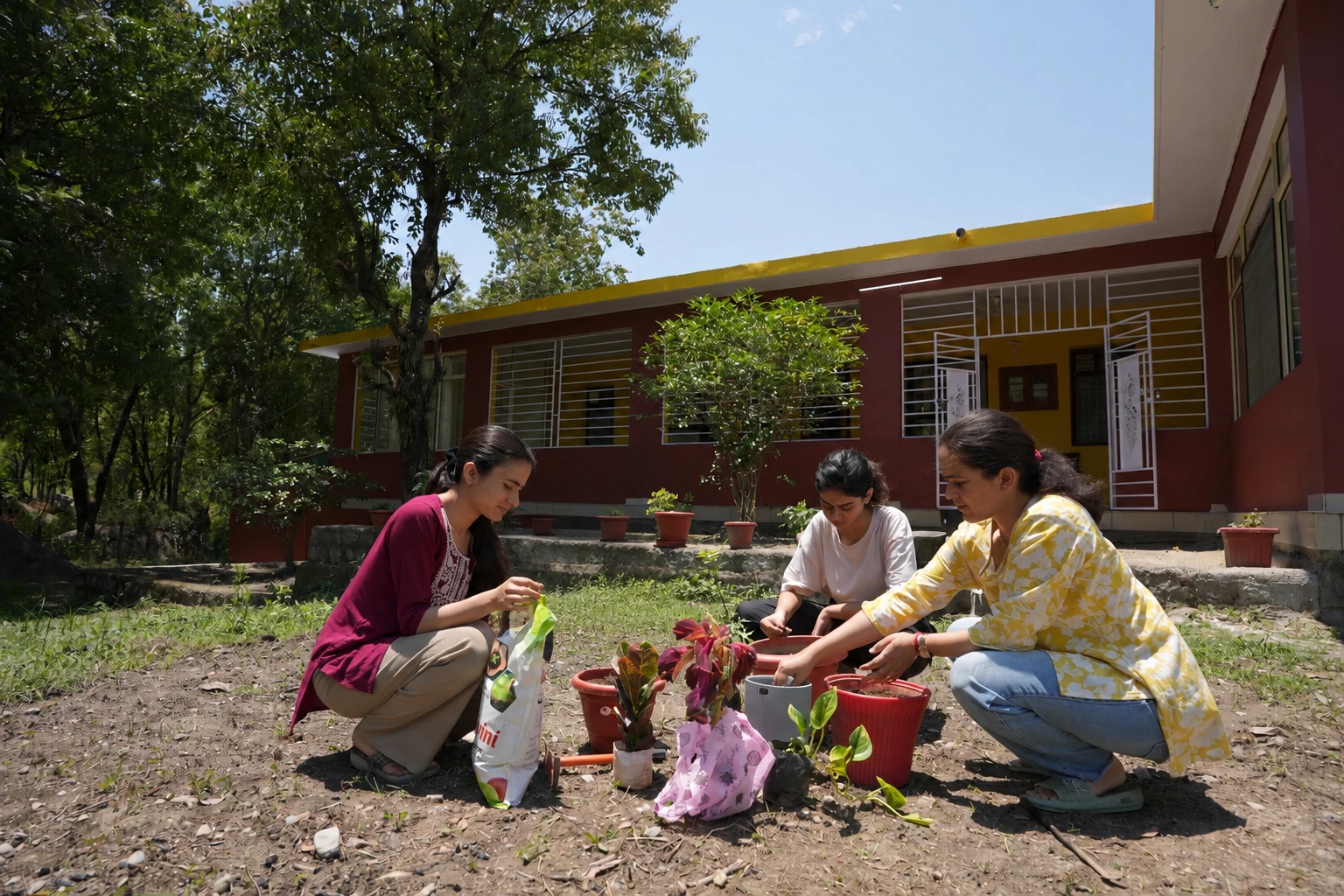
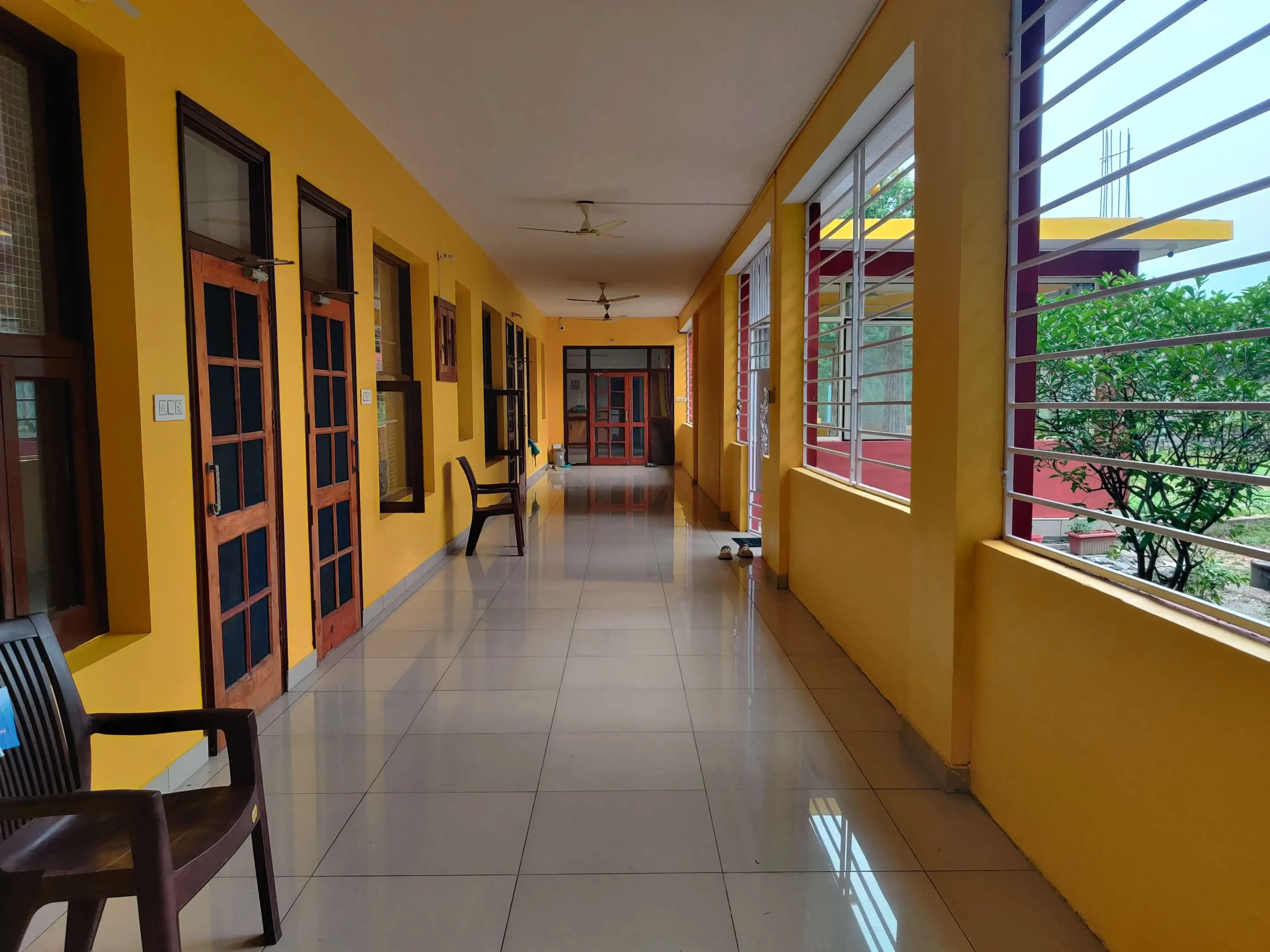
The setting is low-stimulation on purpose: hills, clean air, few screens, few demands. It is not a luxury retreat and we do not describe it as one. It is a calm, ordered, affordable place to do difficult work.
How long a stay lasts
There is no single correct length, and anyone who quotes you one without knowing your history is guessing.
- 15 days. Stabilisation and reset. Suitable where dependence is mild or where a woman has strong support waiting at home.
- One month. The most common. Long enough for detox, for the psychological work to gain traction, and for a new routine to hold.
- Longer. For long-standing dependence, repeated relapse, or where returning home immediately would be unsafe.
The honest position from the research is that longer engagement predicts better outcomes. But a shorter stay a woman actually agrees to is worth far more than a long one she is forced into and leaves in week two.
Family, discharge, and after
Families are involved on scheduled days, with your consent. That involvement is not a formality. It is often where the difficult conversations finally happen, and where a household begins to understand its own part in what has been going on.
Before you leave, you and your counsellor write a plan together: what your first week home looks like hour by hour, who you call at 11pm, which gatherings you skip this year, what you say when someone offers. It is written down because memory is unreliable under pressure.
Ongoing peer support is part of the plan, not an afterthought. We connect women to 12-step fellowships such as Alcoholics Anonymous and Narcotics Anonymous, including women-only and online meetings where a local group would mean being recognised, and to SMART Recovery for women who want a self-directed, CBT-based framework without the spiritual element. Neither is compulsory. Some women use both, some use neither, and we help you find what you will actually keep attending.
After discharge, online sessions continue at whatever frequency you need, and you can reach us on WhatsApp between them. If you relapse, we want to hear about it early. A relapse is information about what the plan missed, not proof that you failed, and coming back sooner is always the better outcome.
One conversation is enough to start with.
You do not have to have decided anything. Call, or send the form above, and someone will talk it through with you honestly, including telling you if what you need is something other than us.
- Phone
- +91 82194 74936 · +91 70181 48449
- Message us directly
- Hours
- Monday to Saturday, 10:00 AM to 5:00 PM
Vaishalya Wellness is a residential wellness and counselling centre. It is not a crisis or suicide helpline. If you are having thoughts of harming yourself, please contact a crisis helpline or go to the nearest hospital immediately. For psychiatric emergencies, seek medical care first.

About Vaishalya Wellness
Set in the quiet foothills of the Dhauladhar range in Palampur, Vaishalya Wellness is a women only rehabilitation and recovery centre. We offer a safe, private and dignified space for women seeking professional help with addiction, trauma and mental health, guided by clinical care and genuine compassion.
A women only residential facility in Himachal Pradesh.
Registration No: 2025/238/4/186
What We Treat
Additional Info
Contact
Call us +91 82194 74936 +91 70181 48449
Mohal, Gugga Saloh Rd,Tehsil Sullah, Palampur,
Himachal Pradesh 176102 Get directions
© 2026 Vaishalya Wellness. All rights reserved.
Privacy Policy